Video Lessons
Free video lessons that walk through real exam questions — watch right here with the full transcript, and jump to a practice test when you're done.
AHIMA CCA Practice Test1
Practice this test →
Medical Interpreter (CoreCHI) Practice Test1
Practice this test →
Ophthalmic Assistant (COA) Practice Test1
Practice this test →
Certified Bookkeeper Practice Test1
Practice this test →
FPC Payroll Certification Practice Test1
Practice this test →
Security Guard Practice Test1
Practice this test →
Sterile Processing (CRCST) Practice Test2
Practice this test →
Sterilization methods for the CRCST sterile processing exam: how steam, ethylene oxide and hydrogen peroxide kill, gravity vs dynamic air removal, the Bowie-Dick test, and biological indicators, with three practice questions worked option by option.

CRCST exam guide: how the HSPA sterile processing certification exam works in 2026 and how to pass it.
Surgical Technologist (CST) Practice Test2
Practice this test →
Sterile technique for the CST surgical tech exam: where a gown and a draped table stop being sterile, strike-through, breaks in technique, and event-related sterility for packages, with three practice questions worked option by option.

CST exam guide: how the NBSTSA Certified Surgical Technologist exam works in 2026 and how to pass it.
Civil Service Clerical Exam Practice Test2
Practice this test →
Civil service clerical name and number checking items usually hide one wrong character. Learn the six error types (swapped digits, dropped or doubled letters, look-alikes like 0 and O, spaces, case and real-word twins) and the position-by-position method that catches them.
There is no single civil service clerical exam: states, counties and cities write their own. How the New York State and New York City exams work, why a score of 70 only puts you on a ranked list, and how to prepare for filing, name and number checking, reading and grammar.
Motorcycle Permit Practice Test1
Practice this test →
NATE HVAC Practice Test1
Practice this test →
Crane Operator (NCCCO) Practice Test1
Practice this test →
Optician (ABO) Practice Test1
Practice this test →
Notary Public Practice Test1
Practice this test →
Police Officer Entrance Exam Practice Test1
Practice this test →
HHA Practice Test3
Practice this test →
How home health aide certification works under the federal rule: the 75-hour training minimum, the 16 hours of training required before supervised practical work, who runs the competency evaluation, and how to prepare.

A teaching lesson on HHA personal care, built on the single principle that answers almost every question in the area: cleanest to dirtiest, one direction, fresh surface, never back.

How the Home Health Aide competency evaluation actually works, built on the federal rule that sits underneath every state and agency version (42 CFR 484.80). The headline: you cannot become an HHA by passing a written test.
Postal Exam 474 (USPS) Practice Test9
Practice this test →
Coding and Memory — and first, the disclaimer: this section is NOT on the current Virtual Entry Assessment. It is from the retired postal exam and is carried as bonus practice. The method is still worth knowing.
Clerical Accuracy, part two. Before two names are compared they become indexing units: spaces, apostrophes and capitalization drop out and one plain run of letters is compared from the left.

Work Situations on the USPS Virtual Entry Assessment 474 (VEA 474) is scored as a behavioral profile, which is why candidates who escalate everything and candidates who handle everything alone both lose points.

Clerical Accuracy — filing and sequencing — is not part of the VEA 474. It belongs to the clerk-side clerical battery (USPS Exam 710/730), and the filing rules come from the ARMA International Simplified Filing Standard Rules.

Lesson 4 of the free Quibank Postal Exam course: why No Errors is right about half the time on VEA 474 Check for Errors, and how candidates manufacture differences that were never there.

Work Situations on the USPS Virtual Entry Assessment 474 (VEA 474) is the situational-judgment half of the exam, scored as a behavioral profile rather than as right-and-wrong facts.

Lesson 3 of the free Quibank Postal Exam course: the differences on VEA 474 Check for Errors that survive a glance.

Lesson 2 of the free Quibank Postal Exam course: the four-way key on VEA 474 Check for Errors, the fixed scan order that makes speed safe, chunked ZIP reading, and the three traps — inventing errors on clean pairs, mid-string transpositions, and stopping at the first error.
USPS Postal Exam 474 exam guide: how the Virtual Entry Assessment (VEA) works and how to pass it.
Mortgage Loan Originator (NMLS SAFE) Practice Test31
Practice this test →
Lesson 24 of the free Quibank NMLS SAFE course. An automated underwriting system's Approve/Eligible recommendation is conditional — it is generated entirely from the data keyed in, so the file must still be documented as the findings direct, every condition cleared…

Lesson 25 of the free Quibank NMLS SAFE course. Appraisal independence draws one line: you may give an appraiser information — corrections of factual errors, additional comparable sales, requests for detail — but never pressure, whether a target value, a withheld payment…

Lesson 26 of the free Quibank NMLS SAFE course, and the origination block's final exam: four calculations straight from the question bank. Loan-to-value divides by the lesser of price or appraised value, and the combined ratio adds every lien — 80% and 85% on the worked example.
Lesson 27 of the free Quibank NMLS SAFE course opens the ethics block. The two protected-class lists — ECOA/Regulation B versus the Fair Housing Act — and the gap the exam loves: familial status and disability belong to the Fair Housing Act only.

Lesson 28 of the free Quibank NMLS SAFE course. When a face-to-face applicant declines the government monitoring questions, the MLO notes the decline and completes ethnicity, race, and sex by visual observation or surname — and never guesses on remote applications.

Lesson 29 of the free Quibank NMLS SAFE course closes the ethics block. Affiliated business arrangements are legal only when disclosure comes at or before the referral, the borrower is never required to use the affiliate, and the only benefit is a return on ownership interest.

The finale of the free Quibank NMLS SAFE course: a ten-rule final review of the answers test-takers miss most.

Lesson 18 of the free Quibank NMLS SAFE course. Regulation Z bars four product features from any Qualified Mortgage — negative amortization, interest-only, balloon payments and terms over 30 years — but rate adjustment is not one of them, so a fully amortizing ARM can still be a QM.

Lesson 19 of the free Quibank NMLS SAFE course. Three loan-to-value ratios share one denominator — the lesser of sales price or appraised value — and differ only in the numerator: LTV is the first lien, CLTV adds what is drawn on subordinate financing…

Lesson 20 of the free Quibank NMLS SAFE course, closing out the General Mortgage Knowledge block. One discount point is 1% of the loan amount, never the sales price.

Lesson 21 of the free Quibank NMLS SAFE course, opening Origination Activities — 27% of the exam. Six items make an application: name, income, Social Security number, property address, an estimate of property value, and the loan amount sought — and no seventh item may be added.

Lesson 22 of the free Quibank NMLS SAFE course. Three information rules: what you must collect, what you may ask, and how a document has to travel.

Lesson 23 of the free Quibank NMLS SAFE course. Underwriting a file is four judgments, not one: capacity (income and debt records), capital (the borrower's own money, including post-closing reserves), collateral (the appraisal and title work) and credit (the credit report and payment history).

Lesson 17 of the free Quibank NMLS SAFE course: adjustable-rate mortgages, taught as one addition and a set of ceilings.

Lesson 15 of the free Quibank NMLS SAFE course opens the General Mortgage Knowledge block (20% of the exam) with the government loan programs. The one mechanism behind every answer — insured vs.

Lesson 16 of the free Quibank NMLS SAFE course. Conventional and conforming are two different axes: conventional means no government agency backs the loan, while conforming means Fannie Mae or Freddie Mac can buy it.

Lesson 11 of the free Quibank NMLS SAFE course: the SAFE Act licensing standards.

Lesson 12 of the free Quibank NMLS SAFE course: education and testing rules in depth. The 20-hour and 8-hour patterns, the successive-years no-repeat rule, the no-banking rule, the 75%/30-day/6-month retake ladder, and the 5-year test-result expiry with its registered-time exclusion.

Lesson 13 of the free Quibank NMLS SAFE course: keeping the license. The approved-inactive sponsorship rule (no originating without an employer's NMLS sponsorship; job changes re-run it), the three annual renewal requirements…

Lesson 14 of the free Quibank NMLS SAFE course completes the Uniform State Content: temporary authority (the 1-year registered path vs the 30-day licensed-elsewhere path, and the four ending events)…

Lesson 10 of the free Quibank NMLS SAFE course: the Bank Secrecy Act and borrower privacy.
Lesson 7 of the free Quibank NMLS SAFE course: TRID part 2. The Closing Disclosure's 3-business-day receipt rule, the only three changes that restart it (APR inaccurate, product change, prepayment penalty added)…

Lesson 8 of the free Quibank NMLS SAFE course: HOEPA's three high-cost triggers (APR spread, points and fees, prepayment penalty) and the consequences (mandatory HUD-approved counseling; prepayment penalties, balloons, and negative amortization banned)…

Lesson 9 of the free Quibank NMLS SAFE course: mortgage advertising. Regulation Z's four trigger terms and the required disclosure trio (down payment, repayment terms, APR), the state bait-and-switch rule (advertised terms must be actually available — disclaimers don't cure)…

How the NMLS SAFE MLO exam actually works: 120 questions, 190 minutes, 115 scored, scaled score of 75 to pass. The five content areas and their weights, the licensed-vs-registered two-track system, and the retake ladder (30 days between attempts, six months after three straight fails).

Lesson 2 of the free Quibank NMLS SAFE course: the SAFE Act's definition of a mortgage loan originator (take an application OR negotiate terms — either alone triggers licensing), the processor/underwriter exclusion (supervised employees only — never independent contractors)…

Lesson 3 of the free Quibank NMLS SAFE course: TILA and Regulation Z. What goes into the finance charge (points, prepaid interest, mortgage insurance) and what stays out (title, appraisal, recording), when the right of rescission exists (non-purchase-money lien on the principal dwelling)…

Lesson 4 of the free Quibank NMLS SAFE course: RESPA and Regulation X. Section 8's kickback ban (things of value include gift cards — no nominal-value exception, no disclosure cure), the three conditions of the affiliated business arrangement exception…

Lesson 5 of the free Quibank NMLS SAFE course: ECOA and Regulation B. The nine prohibited bases and the ECOA-vs-Fair-Housing comparison (ECOA-only: age, marital status, public assistance income), the spouse-signature rule (qualified alone means no required spouse signature)…

Lesson 6 of the free Quibank NMLS SAFE course: TRID part 1. The six-item application definition (and the eliminated seventh catch-all), the Loan Estimate's 3-business-day delivery deadline, and the 7-business-day waiting period before consummation.

How the NMLS SAFE Mortgage Loan Originator test works, built from the NMLS MLO Testing Handbook and the official content outline. The headline: 75% to pass sounds round, but the scored count is 115, so the real target is 86 correct — and 85 is a fail.
Firefighter Written Exam Practice Test5
Practice this test →
Lesson 2 of the free Quibank Firefighter course: the four reading-comprehension question shapes (literal detail, best title, EXCEPT, rule application), why outside knowledge is a trap, and the three-move method for every passage.

Lesson 3 of the free Quibank Firefighter course: the engineered wrong answers of the math section — order of operations, common denominators, and the complement trap — plus the ten-second check that defeats all three.

Lesson 4 of the free Quibank Firefighter course: the 0.433 psi/ft and 2.31 ft/psi conversions, the depth-not-shape principle behind the trick questions, friction loss, and the force-for-distance trade behind every lever and pulley item.

Lesson 5 of the free Quibank Firefighter course closes the four abilities: sketch-first setup, the no-backtrack rule, absolute one-ways, stem conditions overriding the map, and the impossible-move freebie.

Firefighter written exam guide for 2026: how the firefighter entrance exam actually works and how to pass it.
Court Interpreter Written Exam Practice Test6
Practice this test →
Lesson 2 of the free Quibank Court Interpreter course: Canon 1, accuracy and completeness.

Lesson 3 of the free Quibank Court Interpreter course: the role-keeping canons. Conflict disclosure on the record, the ban on opinions and gifts, confidentiality that covers overheard privilege and outlives the case, the no-legal-advice scope rule…
Lesson 4 of the free Quibank Court Interpreter course: the three modes and their triggers (simultaneous for proceedings, consecutive for testimony, sight translation for documents), chuchotage, the first-person/third-person convention, requests through the judge, positioning and audibility…

Lesson 5 of the free Quibank Court Interpreter course: the terminology traps — with/without prejudice, nolo contendere and its civil-suit shield, concurrent vs consecutive, probation vs parole, own recognizance, the courtroom idioms (come clean, beat around the bush, cut a deal, scot-free)…

Lesson 6 of the free Quibank Court Interpreter course, closing the four-domain block: the courtroom cast (bailiff = order + jury custody), the case arc and jury-charge sequence, hung juries and overruled objections, and the credentialing path — written exam first, one requirement met…

How certification actually works (state programs, NCSC-developed exams, the separate federal FCICE), and why the written exam is one shared body of knowledge across all language pairs.
CAPM Practice Test1
Practice this test →
EKG Technician (CET) Practice Test1
Practice this test →
Private Pilot Written Test Practice1
Practice this test →
Home Inspector Practice Test (NHIE)1
Practice this test →
Food Manager Practice Test1
Practice this test →
Forklift Operator (OSHA) Practice Test1
Practice this test →
OSHA 10 / 30 Practice Test1
Practice this test →
CPA Exam Practice Test1
Practice this test →
MBLEx Massage Therapy Practice Test1
Practice this test →
RBT Practice Test1
Practice this test →
Enrolled Agent (SEE) Practice Test1
Practice this test →
EPA 608 Certification Practice Test1
Practice this test →
Series 7 Practice Test1
Practice this test →
CompTIA Network+ Practice Test1
Practice this test →
Cosmetology Practice Test2
Practice this test →
A cosmetology concept lesson on decontamination — taught as a ladder rather than a list, so the rules derive themselves instead of being memorized. Infection control sits inside Scientific Concepts, 35% of the NIC cosmetology theory exam, and is the most heavily tested area within it.
How the cosmetology state board written exam actually works, built from the NIC National Cosmetology Theory Examination Candidate Information Bulletin (effective July 1, 2022, revised January 1, 2026).
Dental Assistant (DANB) Practice Test1
Practice this test →
FAA Part 107 Drone Pilot Practice Test2
Practice this test →
A Part 107 concept lesson on airspace — built around the single conversion that most airspace questions are really testing: charted altitudes are MSL, and your 400-foot limit is AGL.
How the FAA remote pilot knowledge test works, built from the FAA's Airman Knowledge Testing Matrix and the Remote Pilot Airman Certification Standards.
CPC Medical Coding Practice Test2
Practice this test →
How the AAPC Certified Professional Coder exam works, built from AAPC's own published exam information. The headline: the CPC is an open-book exam, and that is not the advantage it sounds like.
A CPC concept lesson on the global surgical package and the three E/M modifiers that come out of it — 25, 57 and 24. The idea: these are not three rules to memorize. They are three consequences of one rule.
ASE Automotive Technician Practice Test1
Practice this test →
Insurance License Practice Test1
Practice this test →
SIE Practice Test1
Practice this test →
CompTIA A+ Practice Test1
Practice this test →
TEAS Practice Test1
Practice this test →
CDL Practice Test1
Practice this test →
CompTIA Security+ Practice Test1
Practice this test →
Food Handler Practice Test1
Practice this test →
Personal Trainer (CPT) Practice Test1
Practice this test →
PMP Practice Test1
Practice this test →
Medical Assistant Practice Test1
Practice this test →
CNA Practice Test2
Practice this test →
A teaching lesson on the biggest area of the CNA written test: Basic Nursing Skills, at 35% of the exam. Taught from zero.

The full picture of the Certified Nursing Assistant exam AND how to prepare for it.
CPR, AED & First Aid Practice Test2
Practice this test →
A teaching lesson on recognising cardiac arrest - the decision that comes before the compressions, and the one most bystanders get wrong.

How CPR certification actually works, and the numbers you need to know cold, based on the 2025 AHA Guidelines for CPR & ECC. The headline: there is no national CPR exam.
EMT (NREMT) Practice Test2
Practice this test →
A teaching lesson on the heaviest area of the NREMT EMT exam: Primary Assessment, at 39-43% of the exam. Taught from zero, no prior knowledge assumed.
The full picture of the NREMT cognitive exam AND how to prepare for it. The headline: NREMT rebuilt the EMT blueprint around the patient-care process, while most study guides still teach the old five areas (airway, cardiology, trauma, medical, operations).
NCLEX-RN Practice Test2
Practice this test →
A teaching lesson on the biggest area of the NCLEX-RN: Management of Care (15-21% of the exam — heavier than pharmacology). Taught from zero, no prior knowledge assumed.

A full picture of the NCLEX-RN nursing licensure exam AND how to prepare for it.
Phlebotomy Technician Practice Test2
Practice this test →
A teaching lesson on the phlebotomy order of draw - taught from the reason up so you can rebuild it rather than recall it. Routine Blood Collections is 28% of the exam, the largest single domain.

The full picture of the NHA Certified Phlebotomy Technician (CPT) exam and how to prepare for it.
Pharmacy Technician (PTCB) Practice Test2
Practice this test →
A teaching lesson on PTCB Patient Safety and Quality Assurance - 23.75% of the PTCE, part of the 65% that isn't drug names. Taught from zero.

The full picture of the PTCB's PTCE exam AND how to prepare for it. The headline: Medications is only 35% of the exam, so nearly two-thirds of your points come from patient safety…
ASVAB Practice Test6
Practice this test →
The full picture of the military enlistment test AND how to prepare for it. We cover where you take it (MEPS and MET sites), what the AFQT actually is and why it's only 4 of the ASVAB's 10 tests, why your AFQT is a percentile rather than a percentage…

12 real ASVAB Arithmetic Reasoning (AR) math word problems with worked answers — rates, percents, ratios, averages, interest, and the classic average-speed trap. Arithmetic Reasoning is one of the four AFQT subtests that decide enlistment eligibility.

12 real ASVAB General Science (GS) practice questions with clear answers, across biology, earth & space, chemistry, and physics. General Science isn't part of the AFQT, but your score helps decide which military jobs you qualify for. Practice the full ASVAB free at quibank.com/en/asvab.

12 real ASVAB Math Knowledge (MK) practice questions with worked answers — solving equations, exponents, factoring, area & volume, the Pythagorean theorem, slope, and more. Math Knowledge is one of the four AFQT subtests that decide enlistment eligibility.

6 real ASVAB Paragraph Comprehension (PC) practice passages with clear answers — main idea, stated detail, sequence, inference, word-in-context, and author's purpose. Paragraph Comprehension is one of the four AFQT subtests that decide enlistment eligibility. Practice the full ASVAB free at quibank.

12 real ASVAB Word Knowledge (WK) practice questions with clear answers. Word Knowledge is one of the four AFQT subtests that decide your enlistment eligibility.
Real Estate License Practice Test10
Practice this test →
A teaching lesson (not a drill): we explain real estate agency from zero, then break down how the exam asks it. Covers what an agent is, the three agent types by scope (general / special / universal), ostensible vs actual authority, and two exam questions worked option-by-option — why the right answ

A teaching lesson: contracts (~12%) and transfer (~8%) on the California real estate exam. Covers the four contract essentials (consideration), novation, void vs voidable (a minor's contract is voidable), listings (exclusive right to sell vs open), and the quitclaim deed — with exam questions worked
A teaching lesson (not a drill): we explain the most-tested area of the California real estate exam — practice & disclosures (~25%). Covers the Transfer Disclosure Statement and its foreclosure exemption, the Easton visual-inspection duty, agency disclosure (Disclose → Elect → Confirm), dual-agent c

A teaching lesson: financing (~9%) and valuation (~14%) on the California real estate exam. Covers the deed of trust (trustor / trustee / beneficiary; who holds naked title), FHA insurance vs VA guarantee, and the three approaches to value — including a step-by-step of the income approach (Value = N

A teaching lesson: property ownership & estates on the California real estate exam (~15%). Covers fee simple absolute, life estates (remainder vs reversion) with an intuitive analogy, joint tenancy's four unities and right of survivorship, easements (appurtenant vs in gross), and the government's fo

Episode 2 of the Quibank California Real Estate series drills the exam's most heavily tested cluster: laws of agency and disclosure. Ten real practice questions with answers and one-line explanations — fiduciary duties (ACOLD), agent types, ostensible authority, ratification, California's Disclose-E

Episode 5 of the Quibank California Real Estate series drills contracts (~12%), listings, and transfer of property (~8%). Ten real practice questions with answers and one-line explanations: the four contract essentials, voidable vs unenforceable contracts, options, California's Statute of Frauds, ex
Episode 4 of the Quibank California Real Estate series drills financing (~9%) and valuation (~14%). Ten real practice questions with answers and one-line explanations: the promissory note vs the security instrument, deed of trust parties, acceleration clauses, FHA insurance, judicial vs non-judicial
Episode 1 of the Quibank California Real Estate series — a full picture of the DRE salesperson licensing exam AND how to prepare for it. We cover how it works (150 questions, 3 hours), the passing score (70%, or 105 correct), the 135-hour three-course prerequisite, the seven weighted subject areas,
Episode 3 of the Quibank California Real Estate series drills property ownership and land use (~15% of the exam). Ten real practice questions with answers and one-line explanations: fee simple absolute, life estates (remainder vs reversion), joint tenancy's four unities and right of survivorship, te
U.S. Citizenship Civics Test10
Practice this test →
A full walkthrough of the 1800s section of the 2025 U.S. citizenship civics test — 10 official questions (numbers 90–99).

A full walkthrough of the Colonial Period and Independence section of the 2025 U.S. citizenship civics test — 17 official questions (numbers 73–89).

A full walkthrough of the Recent American History section of the 2025 U.S. citizenship civics test — 19 official questions (numbers 100–118). Covers the world wars and why the U.S.

A full walkthrough of the executive branch on the 2025 U.S. citizenship civics test — 15 official questions (numbers 17, 36–49).
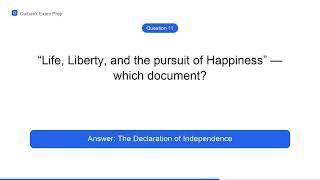
A full walkthrough of the Principles of American Government section of the 2025 U.S. citizenship civics test — all 15 official questions (numbers 1–15), each with its answer.
A full walkthrough of the judicial branch and federalism on the 2025 U.S. citizenship civics test — 13 official questions (numbers 50–62).
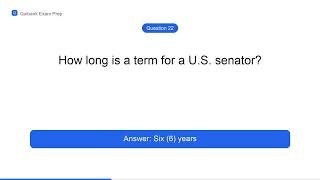
A full walkthrough of the legislative branch (Congress) on the 2025 U.S. citizenship civics test — 19 official questions (numbers 16, 18–35).
A full walkthrough of the Rights and Responsibilities section of the 2025 U.S. citizenship civics test — 10 official questions (numbers 63–72).
A full walkthrough of the Integrated Civics section of the 2025 U.S. citizenship civics test — all 10 official questions (numbers 119–128), split into symbols and holidays, each with its answer and a quick note to help it stick.

We introduce the U.S. naturalization civics test: how the spoken interview works, which version you take (the 2008 100-question test vs the 2025 128-question test, decided by your Form N-400 filing date), the three content areas, how scoring works, and the study habits that actually move the needle — plus three real practice questions.