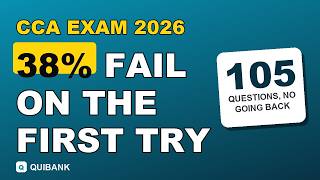
CST Surgical Tech Exam 2026: How It Works and How to Pass
CST exam guide: how the NBSTSA Certified Surgical Technologist exam works in 2026 and how to pass it.
Transcript
Here is exactly how the CST exam works, and how to pass it, in about six minutes. Certified Surgical Technologist is the nationally recognized credential for surgical technologists, required in some states and preferred by most employers, and the exam behind it is more predictable than it looks once you see how the questions are distributed. The exam is owned and written by the NBSTSA, the National Board of Surgical Technology and Surgical Assisting. It is computer-based and entirely multiple choice, and the certification program itself is accredited by the National Commission for Certifying Agencies.
One consequence is worth knowing up front: the NBSTSA is the sole authority on whether you are eligible, so anything a prep site tells you about qualifying is secondhand. The format is one hundred seventy-five multiple-choice questions in four hours. Only one hundred fifty of them are scored. The other twenty-five are pretest items, scattered at random so the board can trial future questions.
You cannot tell which is which, so never write off a strange-looking question as probably an unscored one. That is a gamble with a scored item. So how many do you need right? This is where most study guides are out of date.
The official content outline deliberately does not print a passing number. It tells candidates to check the board's own website for the current figure. Today the NBSTSA site says ninety-eight of the one hundred fifty scored questions, about sixty-five percent, and that is lower than the number many guides still repeat. Check it yourself the week you register.
Eligibility is narrow, and it is where most people actually get stuck. To sit for the CST exam you must graduate from a surgical technology program accredited by CAAHEP or ABHES. Graduates of a formal surgical technology training program completed during military service also qualify. There is no work-experience route, so years of scrubbing on the job will not by themselves earn you a seat.
Confirm your program's accreditation before you plan anything else. Now, what is actually tested. There are three content areas, and they are wildly uneven. Perioperative care is sixty-five percent of the exam, ninety-seven of the one hundred fifty scored questions.
Basic science is twenty percent, thirty questions. Ancillary duties is fifteen percent, twenty-three questions. That imbalance is the most useful fact in the whole outline, because it tells you where your study hours belong. Each area splits further, and two sub-areas are worth naming.
Inside perioperative care, intraoperative procedures is sixty-eight questions all by itself, while postoperative procedures is only ten. Inside basic science, anatomy and physiology is eighteen of the thirty. The rest are small, six here and seven there, and none of them will make or break your result. Sit with that sixty-eight for a second.
It is closer to half of your scored exam than to a quarter of it, while everything before the incision is nineteen questions. So if you are studying the phases of a case evenly, you have it backwards. This exam lives between incision and closure. Here are three real questions in the exam's own style.
First: in which area of the surgical suite is a mask required in addition to a scrub suit and head covering? The answer is the restricted area, which includes the operating rooms, the sub-sterile rooms and the scrub sink areas. The reasoning matters more than the label. Attire escalates zone by zone because the restricted zone is where sterile supplies get opened and sterile fields get built, so droplets from your nose and mouth could reach them.
Second: during a small-bowel resection the surgeon asks for an instrument to grasp and lift a loop of intestine without crushing it, a ringed instrument with fenestrated, flared jaws and a smooth, toothless inner surface. That is the Babcock. Notice how the question is built. It never shows you a photograph, it describes the jaw pattern and the job.
Learn instruments by what the jaw does to tissue, and you can answer a question about an instrument you have never held. Third, a judgment question, and this one is the archetype for the whole exam. The closing count is incorrect and one sponge cannot be located. What has to happen first?
Tell the surgeon immediately, so the field and the room are searched and the wound can be explored before it is closed. The trap is the reasonable-sounding option: repeat the count, and if it matches, document it and move on. An incorrect count is a patient-safety event, not a paperwork problem. When an answer choice quietly protects the schedule instead of the patient, that is your distractor.
So how do you prepare? Four things. One: drill practice questions until the rules are automatic, and aim well above the passing line rather than at it, so exam day has margin in it instead of a coin flip. Two: master the vocabulary.
An enormous share of these questions turn on a single word. Fenestrated. Radiopaque. Dispersive.
Semi-restricted. If the word is fuzzy, the question is unanswerable no matter how much operating room time you have. Three: keep a written list of every question you miss, look for the pattern, and weight your remaining time toward the heavy areas, which means intraoperative procedures first and anatomy and physiology second. Four: read carefully and manage the clock.
Four hours for one hundred seventy-five questions is a little over eighty seconds each, which is genuinely comfortable, so your real risk is not running out of time. It is moving too fast past the words that decide the answer, like first, essential, and not. Quick recap. One hundred seventy-five questions, one hundred fifty scored, in four hours.
Get the current passing number from the board's website, because the content outline does not print it. Eligibility runs through a CAAHEP or ABHES accredited program. Perioperative care is sixty-five percent of your score, and intraoperative procedures alone is sixty-eight questions. Study the case itself, learn instruments by function, and when an option protects the schedule instead of the patient, do not choose it.
You can practice all of this free right now. Quibank has free CST practice questions with a written explanation for every answer, at quibank.com/en/surgical-tech. Good luck in the operating room.
More episodes